
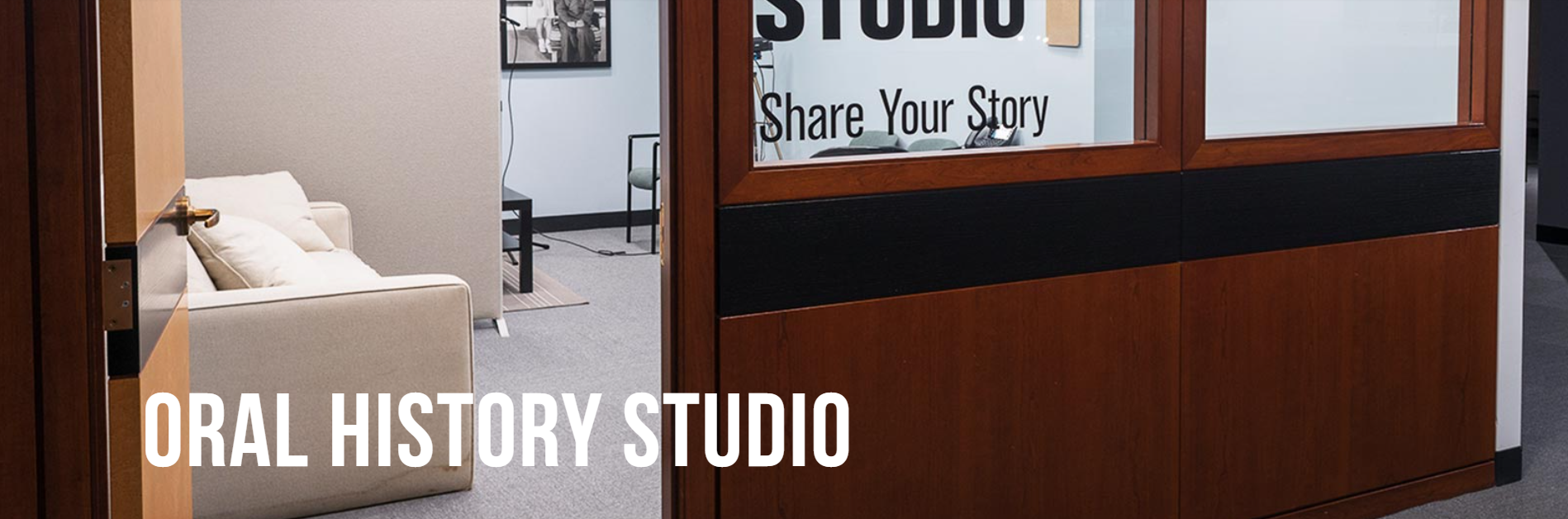
Share Your Story.
The Oral History Studio was a private space within the exhibition where visitors were invited to record their personal stories or reflections. As this exhibition and the gallery have closed, we are no longer asking for submissions. We are grateful to everyone who chose to share their stories with us.
Featured Story
Oral History Project
Over the course of the exhibition, nearly 80 oral histories were recorded via the Oral History Studio. This oral history project, which documents first-hand experiences of the WWII incarceration and resettlement of Japanese Americans, will continue under the auspices of the Japanese American Service Committee (JASC) of Chicago beginning in January 2018. Interested participants may request an appointment to record using the form below.
Aylen Hasegawa
Aylen Hasegawa was born on February 19, 1942, the day that Franklin D. Roosevelt signed Executive Order 9066. He and his family lived on a farm near Puyallup, Washington before the evacuation orders were implemented. After spending about two and a half years in Minidoka concentration camp, his father applied for indefinite leave and relocated to Rockford, Illinois. In this clip, Aylen describes his father’s experiences of leaving camp and trying to adjust to a new town, despite facing economic struggles and racial hostility.
Paul Arakawa & Susie Kimura
Paul Arakawa and Susie Kimura are longtime family friends. Though from different parts of California, the two recall how the FBI detained Japanese American leaders in their communities at the start of the war. As a precautionary measure, both families burned any objects they feared could be used against them as evidence of loyalty to Japan. Once the U.S. declared war, many Japanese American families burned or buried family photographs, documents, and heirlooms to avoid suspicion and arrest.
Michiko Frances Chikahisa
Frances Chikahisa, whose family was sent to Santa Anita racetrack and Rohwer concentration camp during the war, notes that family routines and dynamics were disrupted in camp. Due to the cafeteria-style meal system, for example, many families no longer ate together as children and parents would separate for meals. While many describe this as loss of parental control, Frances explains how her father resisted and would have the family bring food back to their barrack in order to maintain some semblance of normal family activities.
Kazuko May Fujishima
When Kazuko May Fujishima’s family learned about the evacuation orders, her father purchased three large trunks. She explains how he filled them with the family’s valuables, and left them with a trusted family friend. “We were lucky,” she explains, as many families who did the same did not receive their valuables back after the war.
Gary K. Hasegawa
“I think that in a strange way, the experience toughened us up…But I certainly would not want this to happen to anybody else, to anybody.” Gary Kenji Hasegawa discusses the impacts that the camps had on his parents and his family.
Gwen Castle Heaton
In 1944, Gwen Castle Heaton was a student at William Penn College (now, William Penn University) in Oskaloosa, Iowa. At that time, the college was accepting Japanese American students who were incarcerated during the war. In the following clips, Gwen describes how the president of the Quaker college, Cecil Hinshaw, made efforts to invite non-White students to attend despite the racial hostility that existed in the local area during that time. She provides an example of the discrimination faced by Black and Japanese American students.
Helen Ideno
When Helen Ideno was an infant, she and her family were sent to live in a horse stable at Santa Anita racetrack before being transferred to Amache concentration camp. By the time Helen was a high school student, she found that there was no mention of the camps in her history textbooks. She describes how, in 1958, the principal at Marshall High School in Chicago censored her speech as valedictorian when she referenced her family’s experiences during World War II.
Joyce Kubose
Joyce Kubose was born in Chicago to Reverend Gyomay and Mrs. Minnie Kubose, who founded the Chicago Buddhist Church (now the Buddhist Temple of Chicago) in 1944. In this oral history, Joyce describes the lives of her parents and how they came to be great leaders not just within the Japanese American community of Chicago, but in the fields of American Buddhism and Japanese tea ceremony, as well. She also describes her own experiences of growing up as a Sansei on Chicago’s south and north sides.
Gene Kazuo Ideno
Gene Kazuo Ideno’s father was picked up by the FBI at the onset of the war and sent to a Department of Justice (DOJ) camp in Santa Fe. Meanwhile, Kazuo was sent with his mother and baby brother to camp in Rohwer, Arkansas. Through censored correspondence, Kazuo’s father instructed his family to meet him at the DOJ camp in Crystal City, which held prisoners of German, Italian, and Japanese ancestry. In this clip, Kazuo reflects on his feelings as a young person about his identity as an American.
Eunice Kurisu
Eunice Kurisu’s family had exactly one week to leave their mother’s chicken farm when the evacuation orders were announced in April 1942. Her family was first sent to live in horse stables at the Santa Anita Racetrack before being transferred to Jerome concentration camp in Arkansas. In order to apply for indefinite leave from camp, inmates needed to secure employment before departure. Eunice explains how she was able to leave camp in June 1943 to live in Chicago’s Hyde Park neighborhood as a domestic worker.
Minoru Imamura
“I just felt so hard for my dad and mother. That they were able to buy a farm for their sons, and then plant a crop that is ready to harvest, and to lose it all. It’s very painful. That’s what my feeling was all through my years in camp and when I was in the service, too.” In this oral history, Min describes his experiences of being incarcerated in Amache concentration camp, of serving as a replacement for the 442nd, and of ultimately settling in Chicago.
Junko Mizuta
In the evening after Pearl Harbor was attacked, the FBI arrested Junko Mizuta’s father without providing any information about where they were taking him or his alleged crime. He was transferred between four or five different Department of Justice camps throughout the war while the family was sent to Minidoka concentration camp, unaware of his location. In this clip, Junko describes her father’s arrest and the events that followed.
Susumu Mukushina
Susumu Mukushina was born in October 1942, just before his parents were sent to Heart Mountain concentration camp. With the conclusion of the war, the family went to Seabrook Farms, New Jersey before moving to Chicago, where there was word of better financial opportunity. “Our neighbors were mostly cockroaches,” he recalls, describing his first home on Chicago’s South Side. In this clip, Mukushina explains the housing discrimination that existed in Chicago at that time.
Mary Ozaki
Mary Ozaki’s parents were U.S.-born farmers outside of San Diego before the start of the war. After settling in Los Angeles and starting a family, they were transferred between Tule Lake, Gila River, and Crystal City camps. In this clip, Mary describes being released from camp to Seabrook Farms, New Jersey, where her parents worked on a farm. After getting word that a cousin had housing property in Chicago, Mary and her family moved to the city in 1949.
Stephen Tomoji Saka
Stephen Tomoji Saka was ten years old and living in Los Angeles when WW II broke out. With his four siblings and single mother, Steve was sent directly to Manzanar concentration camp in 1942. In his oral history, he explains how the camps in fact helped his family as they had been previously living in poverty, receiving most support from a local Catholic Church. In this clip, Steve explains some of the impacts of the war, including his name change when he left Manzanar for Ann Arbor, Michigan.
The Sugano Cousins
Susie, Patti, Makoto and Dean are cousins and children of the six Sugano brothers. Together, they describe their fathers’ experiences during and after the war. They explain that four of the brothers were incarcerated in Gila River concentration camp, while one brother lived outside of the exclusion zone and was not imprisoned, and another decided against returning to the U.S. from Japan. Most of the brothers eventually resettled to Chicago, where they founded the National Chick Sexing Association and were leaders in the chick sexing industry.
Mary F. Taira
Mary Taira, whose photograph is displayed in the exhibition, describes the events that took place after the photograph was taken. Her family was removed from their home in Los Angeles, California and detained in Santa Anita racetrack. They were later transferred to Amache concentration camp in Grenada, Colorado. The photograph was taken as her family was boarding the train to Santa Anita.
Anne Watanabe
“It was treated as sort of a footnote in my family.” Anne Watanabe is a fourth generation (Yonsei) Japanese Canadian, whose family was incarcerated in the Tashme and Lillooet camps in British Columbia during World War II. Anne explains how the incarceration of her family was rarely discussed, and describes her experience of learning about internment as “piecemeal.”
Gary Yamagiwa
“And that’s when what had happened…first really hit me.” Gary Yamagiwa was born in Chicago to parents who resettled from Poston and Tule Lake concentration camps. In this clip, Gary describes witnessing the public hearings hosted by the Commission on Wartime Relocation and Internment of Civilians (CWRIC) in 1981, which ultimately contributed to the awarding of redress in 1988. For many like Gary, these testimonies provided some of the first details about the incarceration, as many Issei and Nisei did not openly share about their experiences in camp.
Rulie Yamamoto
In 1942, Rulie Yamamoto and her family were sent directly to Tule Lake from their vegetable farm in Brooks, Oregon. After about a year in camp, two of her seven siblings moved to the Chicagoland area for domestic work. At her father’s request, her brother found an apartment building that the family then purchased and leased to incoming Japanese Americans from camp. In this clip, Rulie describes the property and business that her family opened in Chicago’s Clark and Division area to accommodate the growing Japanese American community there.
Iwao (Rocky) Yamanaka
“There was so many Japanese here in Chicago that weren’t here before the war.” Rocky is 90 years old and a Chicago native. When his father was young, he came to Chicago with an American family before returning to Japan as an adult to marry Rocky’s mother. His parents moved to Chicago’s north side to raise a family, where Rocky was born. At the war’s end, Rocky was drafted into the U.S. army and served for two years. When he returned to his hometown, he explains his surprise to find a burgeoning Japanese American population.
